
- the worst horse
Watashi-wa often thinks of the image of racehorses which Shunryu Suzuki uses, in 'Zen Mind, Beginner's Mind', to describe the marrow, or essence, of Zen. Suzuki writes: '…it is said that there are four kinds of horses: excellent ones, good ones, poor ones, and bad ones. The best horse will run slow and fast, right and left, at the driver’s will, before it sees the shadow of the whip; the second best will run as well as the first one does, just before the whip reaches its skin; the third one will run when it feels pain on its body; the fourth will run after the pain penetrates to the marrow of its bones. When you are determined to practice zazen with the great mind of Buddha, you will find the worst horse is the most valuable one. In your very imperfections you will find the basis for your firm, way-seeking mind. Those who can sit perfectly physically usually take more time to obtain the true way of Zen, the actual feeling of Zen, the marrow of Zen. But those who find great difficulties in practicing Zen will find more meaning in it. So I think that sometimes the best horse may be the worst horse, and the worst horse can be the best one.' There is something very comforting in this. The harder something is for you, the more meaningful it is, and hence also the more valuable. Many things are hard for Watashi-wa: yoga, getting up early, sitting zazen, painting, not being grumpy around my parents... None of these come naturally. But because they are so difficult, I realise that they are also very important for me, and I am more motivated to keep trying. The harder something is, the more meaningful it is. That really is something to be grateful for. On a more exalted level, this also applies to the Bodhisattva vows ('Beings are numberless; I vow to save them') and to the commitment to theosis/ θέωση (union with the divine/ becoming a god by grace). Is it even possible? Is it possible for Watashi-wa? I don't know - the difficulty is immense - but it doesn't really matter; there is fullness of meaning in committing to it. - tonsure
Yesterday Watashi-wa went to have his hair cut - 3mm on top, 2mm on the sides. The Cretan barber did a good job, but very little came off the top, so I encouraged him to go a bit shorter. The result is that I now look like a tonsured monk. And it has been bothering me since yesterday.

It is amazing how, when the chips are down, I forget all the lessons that I know so well. In this case: acceptance. We just have to accept the things we cannot change. Befriend the moment. Not live in a state of resistance to what is.

Why is it so hard to put this simple lesson into practice?

Even that question misses the point. Whether it is hard or not does not matter. Unless we want to live in a constant state of inner tension, we simply have to do it. Cease to resist, surrender, whatever you want to call it. Always in the present moment, over and over again.

The reason my tonsure bothers me is, I guess, vanity - it's just not a good look. But that is actually ridiculous, it's been at least 15 years since my hair was something to be proud of. And even back then, I was sowing the seeds of suffering. Pride in one's appearance is an attachment to and identification with form, and now that the form is not what I wanted, I am annoyed. So now I have to accept not just my haircut, but also my annoyance too.
- our friends
Saying 'Yes' to the present moment is the key to inner peace and the doorway to the experience of God, according to Eckhart Tolle. He says that we have to learn to accept the present moment fully, and to see it as our friend.

St. Porphyrios says:

We should regard Christ as a friend. He is our friend. He asserts this himself when he says, ‘you are my friends’... Christ stands outside the door of our soul and knocks for us to open to Him, but he doesn’t enter. He doesn’t want to violate the freedom which he himself gave us... If we open to Him, He will enter and give us everything – Himself – secretly and silently.

According to Tolle, we should see the present moment as our friend. According to Saint Porphyrios, we should see Christ as our friend. Does this mean that Christ is the present moment? Or is always and for ever (νυν και αεί) within the present moment? It's not deductive logic (just because two people both have a friend, that does not necessarily mean that the friend is the same person), but it could be the case.

It would also explain why Zen meditation is primarily concerned with letting go of thoughts and coming to rest in present moment awareness.
- broken record
Sometimes Watashi-wa feels like a broken record. Some things I keep coming back to, over and over again. One of them is suffering, and its relation to the spiritual life.

Today is one of those days. I went to bed early, slept well, and woke up refreshed. I meditated via Zoom with friends in Berlin and Athens. I didn't even get sleepy. In fact, it was unusually pleasurable - there was a kind of thrumming energy which made it easy to sit straight. Breathing felt luxurious.

I read for an hour - an improving book! - and then I noticed the familiar malign energy, tension and tightness in my body, irritability and malaise. I went for a walk,  sat on a bench by the sea, and observed the sensations with as little judgement or reactivity as possible. I started to feel sleepy, so I lay down on the sea wall and snoozed for a while. After that, I felt ok again. Quite peaceful, in fact.

What is this, and where does it come from?

Maybe it is best not to ask those questions. Better just to accept it, and know that I am not alone.

Abba Anthony, one of the Desert Fathers, said to a fellow monk that it belongs 'to the great work of a man...to expect temptations to the last breath.'

Mother Theodora, one of the Desert Mothers, said: '...you should realise that as soon as you intend to live in peace, at once evil comes and weighs down your soul through accidie (sense of boredom), faint-heartedness, and evil thoughts. It also attacks your body through sickness, debility, weakening of the knees, and all the members. It dissipates the strength of the soul and body, so that one believes one is ill and no longer able to pray. But if we are vigilant, all these temptations fall away.'

And yet, Christ says: 'Come to me, all you who are weary and burdened, and I will give you rest. Take my yoke upon you and learn from me, for I am gentle and humble of heart, and you will find rest for your souls. For my yoke is easy, and my burden is light.'

How does one square these?

Well, in truth, I did find rest, but only after a very unpleasant couple of hours. So maybe it has to be that way. For most people, suffering is the great teacher, the great motivator. Until you are fed up of feeling crap, you have very little incentive to look more deeply. That, at least, has been my experience.

Mother Theodora recommends 'vigilance', which is - I think - the same as mindfulness, or the non-grasping, non-resisting awareness of Zen meditation. It is the light of consciousness, and when it is turned on suffering, the suffering will be dissolved, and the light of consciousness will burn more brightly as a result. At least, that's what I have read.

Eckhart Tolle thinks that this is the esoteric significance of alchemy: the base metal of suffering is turned into the pure gold of consciousness. I actually find that a more plausible idea than the alternative - that the greatest minds of the medieval period were obsessed with trying to turn one metal into another.

Even St. Porphyrios reflects this complexity. On the one hand, he states that the spiritual life is one of peace and of bliss:

'When you find Christ, you are satisfied, you desire nothing else, you find peace. You become a different person. You live everywhere, wherever Christ is. You live in the stars, in infinity, in heaven with the angels, with the saints, on earth with people, with plants, with animals, with everyone and everything. When there is love for Christ, loneliness disappears. You are peaceable, joyous, full. Neither melancholy, nor illness, nor pressure, nor anxiety, nor depression nor hell.'

But equally, he recognises that suffering for Christ is an integral part of it:

'That’s what it is! You must suffer. You must love and suffer – suffer for the one you love. Love makes effort for the loved one. She runs all through the night; she stays awake; she stains her feet with blood in order to meet her beloved. She makes sacrifices and disregards all impediments, threats, and difficulties for the sake of the loved one. Love towards Christ is something even higher, infinitely higher.'

So once again, I feel that the broken record has completed another rotation and I am right back where I started.

Have I really learnt anything?

Maybe just this: for most of my life, I have felt that the slumps, the tension, the malaise could be fixed by trying to arrange the external world in such a way as to satisfy my desires: a good meal, a night out, a new possession, an adventure, a new girlfriend, material gain, worldly success etc. But those are distractions, not solutions. That is one thing I know for sure.

And maybe also this: one can suffer, and still be at peace. Indeed, maybe suffering is the gateway to peace. But it is still hard for me to get my head, and my heart, around that.
- venus and venereology
Yesterday was the third and final day of my fast. It was also quite a busy day, being my penultimate day here in the Engadine. Amongst other things, I had an appointment with a dermatologist.

For a few weeks now, my left forearm has been quite itchy. Since there is nothing to see, I assumed it would just go away by itself, but that has not been the case. In fact, it has been getting more itchy. I had my dog here in August, and he was scratching so much that I took him to the vet. The vet diagnosed 'pyoderma' - a bacterial skin infection, and prescribed some very expensive antibiotics. I wondered whether I might have caught the infection from my dog, so it seemed a good idea to see a dermatologist.

I always forget that this is my favourite time of year here. There is a light dusting of snow on the mountains, the larches flame orange and yellow, the nights are already frosty, the days clear and bright. I have been painting too, in the Spinas Valley, but it is tricky because if you paint what you see it doesn't look real. Luminous world problems!
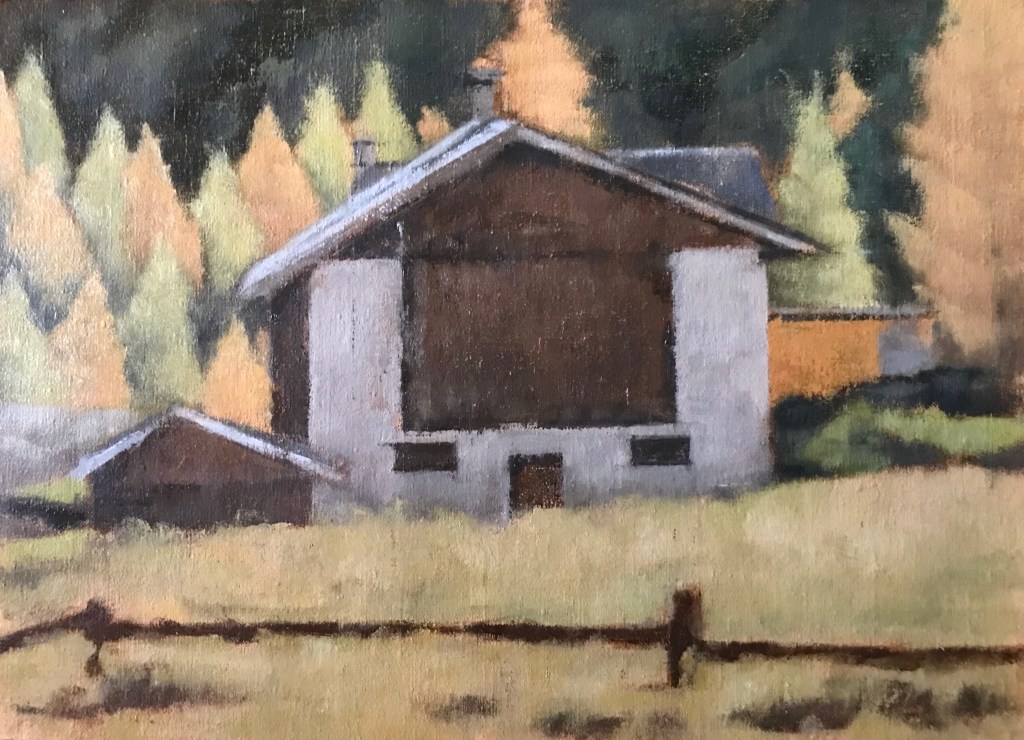
I left early in the morning to take my car to be serviced in the next village. I felt a little weak, so I had a double espresso before leaving. Probably not ideal while fasting, but not technically 'food', and tremendously uplifting! And the morning was so crisp, everything felt so new, so miraculous. I dropped off my car and took the bus to the dermatologist's village, the next one along the valley.

I arrived an hour early and went for a short walk. I stepped into the Swiss Reformed church. It was big and empty. Compared to the Greek Orthodox churches, with their candles and incense and the friendly faces of the Saints covering every inch of wall space, the Swiss Reformed churches seem rather cold and austere places. But there was a worn stone lectern in the middle of this one, and on it a copy of the Bible in gothic script, lying open at Psalm 23 ('Yea, though I walk through the valley of the shadow of death, I will fear no evil'), the very one I have been trying to learn in Greek. Amazing, really, how these Hebrew texts from the Judean desert of the 6th Century BC were translated into Alexandrian Greek and eventually made their way all around the world, including to this little village high up in the Swiss Alps.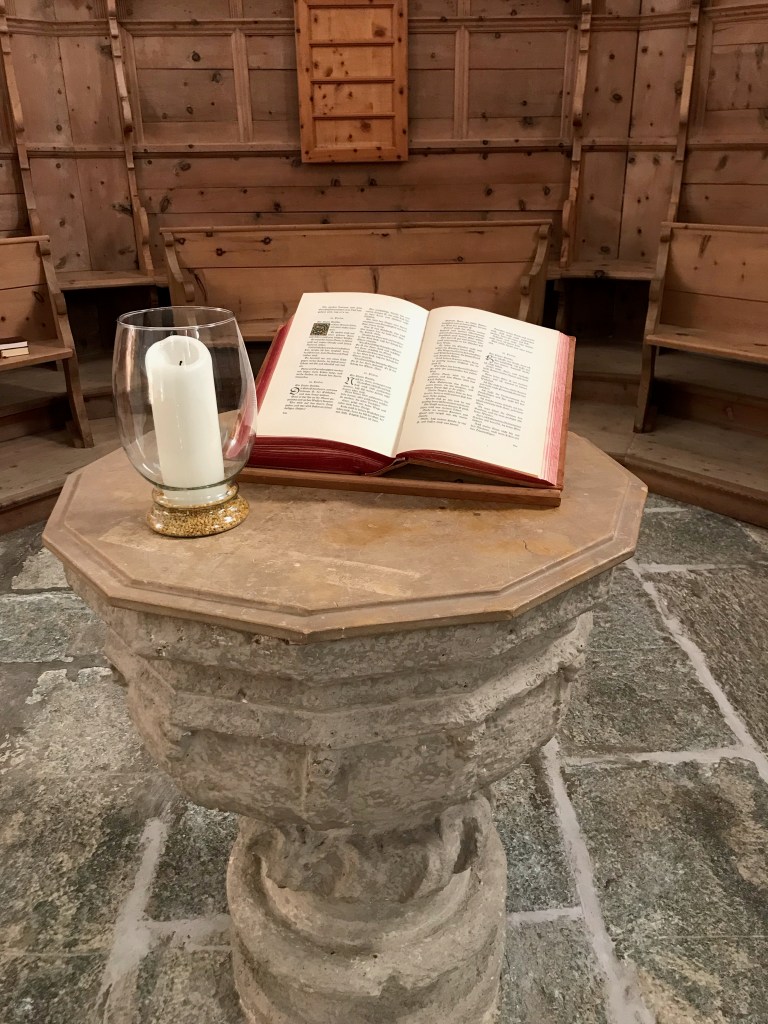

The church was too austere for my taste, but there were a few stained glass windows in the south-facing wall, though oddly not in the eastern one. The sun was now beginning to illuminate them. One of them I found particularly beautiful: it showed Christ standing amongst Alpine meadow flowers, with snowy peaks behind him. This was the Engadine Christ, not the Judean one, and a good reminder for me that the Orthodox Church does not have a monopoly on either religious art, or on the divine.

I completed my tour of the village and went to my appointment with the dermatologist. I was standing at the reception desk when a heart-stoppingly beautiful nurse came to confer with the receptionist... a real Aphrodite.

A few minutes later, the same nurse came to call me through to the dermatologist's office. Then she sat down opposite me.

'Oh, so you are the dermatologist?' I asked.

'Yes. My German is so-so, Italian or English would be better. I am Italian.'

So, a real Venus!

'I am a dermatologist and a venereologist, what brings you here?'

I had found the clinic online, and had skimmed over the description, faintly assuming that a venereologist specialised in veins - 'Venen' in German. But now I realised my error.

'Ah, well, I just have an annoying itch on my arm,' I said, preparing to roll up my sleeve.

'When did you last have a full examination?'

'Oh, years ago... But I really just...'

'I will visit everything,' (I promise she said that), 'Take off your clothes.'

I stripped down to my waist. The three day fast is also a sort of mini-sesshin for me. I have been washing my body, which a Zen monk would not do during a shesshin, but I had been wearing the same underwear and t-shirt for a number of days.

'And my trousers too?'

'Yes.'

I did not, however, remove my underwear. I sat on the bed.

'Do you have any allergies? Do you have a healthy diet?'

'No allergies. Normally my diet is fairly healthy, I think. But I should probably mention that I haven't eaten for three days.'

'A health fast? That can be good too, so long as you know how to do it properly.'

Well, my inspiration comes more from the Desert Fathers than from modish dieting. And not eating does not seem to me to be that complex. But there was no need to go into details.

She instructed me to lie on the bed and proceeded to 'visit' my entire body from extremely close, using something like a jeweler's eye-piece to examine any moles or discolorations. I became very aware of the sweatiness of my armpits, the effect of having drunk the double espresso on an empty stomach earlier that morning. She leaned in close over my shoulders and neck and proceeded to remove my mask. She really was so beautiful. By far the dominant part of me couldn't help thinking: Oh, in another world! I felt that intense and familiar longing. But there was also the small 'voice' that I can occasionally hear, when I am quiet enough and really pay attention; the voice that 'leadeth me beside still waters and restoreth my soul', and that reminds me that all forms of distress are also a lack of trust.

I am afraid that I shall have to disappoint anyone who was hoping for a racy ending to Watahsi-wa's visit. But I am happy to say that the rest of my dermis is unproblematic, and I now have a couple of creams to apply to my itchy arm.

When I got home I was still feeling a bit embarrassed about my unwashed underwear, so I decided to change and do some laundry. On taking off my trousers, I noticed that my boxer shorts - which I had put on half-asleep in the dark that morning - were inside out.

After the ignominy, the laundry!
- my mental model
Watashi-wa has been absent for some time, but now he's back!

I was a bit discombobulated yesterday. I think it was due to a build up of recent travel, consistent wine drinking in the evenings, the desire to celebrate the completion of a new painting, and talking too much. So I have now started a three day fast, with frequent periods of meditation. I have in the past found this to be an excellent re-boot. The Desert Fathers and Mothers were all over it back in the 3rd and 4th centuries, in the Sinai Desert. Of course, they called it 'prayer' rather than 'meditation', but - at least in its contemplative form - it comes to pretty much the same thing.

I stick to water and Japanese green tea during the day, and then a glass of apple juice before I go to bed in the evening. A purist would turn their nose up at the latter, but I find it hard to get to sleep otherwise.

I may be particularly susceptible to fasting: it always amazes me how quickly the mind clears and calms, merely by not engaging one's digestion.

A thought that has been on my mind a lot recently concerns mental models. I am aware that most of the time I walk around with a mental model of how I want the world to be, and that I allow my happiness to be contingent upon that. For instance, I want to return to Athens on Friday, and I am worried that the flights I looked at will no longer be available. Essentially I am saying that I will only allow myself to be happy (content/ relaxed/ at peace with the world) if the reality - the availability of flights - happens to coincide with my mental model, in this case some idea of getting a flight on Friday.

I do this all the time. If I do a 3 day fast, if I move to Crete for November, if I find a nice girl, then I will be happy... But why not just commit to being happy, irrespective of mental models? Do I really need things in the outside world to be a certain way before I can... what... relax? Stop planning? Stop thinking that things could be better? After all, my mental model has coincided with reality countless times in the past, but it never provided lasting happiness. A new model pops up every time. So how about allowing myself to be happy, irrespective of mental models?

(I owe this insight to Michael Singer and his excellent book, 'The Untethered Soul').
- Bombay and Bertrand
My friend Bombay Kris, who has been reading Bertand Russell's 'Marriage and Morals', recently sent me this:

'Fact is, when love and sex collide - it can't be planned nor should it be. As Russell says.
So to look for this is a fool's errand.
It happens when it happens and it would be greedy to ask for more.'

Bombay and Bertrand make an excellent point.
- no angel
Watashi-wa is no angel, that is for sure.

Last week I watched the England-Ukraine football match with friends outside a bar in Exarcheia. I really didn't care who won, but the game made me feel very nostalgic - nostalgic for a time when I really did care who won, and nostalgic, more generally, for an earlier period in my life. Nostalgic, too, for visiting new countries and exploring new cultures. Like the Ukraine, where I have never been.

I love Athens, but life here - as anywhere, I suppose - can feel rather same-y. I felt nostalgic too for the time in my life when I might go out and wake up in a place I had never been before - the sofa in a friend's apartment more often more often than a girl's bedroom, but still, a bit of an adventure; some unpredictability, such as I experienced years ago in New York, and then later in San Francisco. That never happens to me here, probably because I am older, but maybe also because Greeks are more conservative in that way.

After the game, and a couple of flasks of raki, Watashi-wa was pretty drunk, but I did not want to go home. I phoned a reliable dealer (they exist) and bought some cocaine. That sobered me up. Then I went to my favourite dive bar where I can generally rely on bumping into friends. There were two girls chatting alone at a table, one blessed (or cursed) with severe Greek beauty. Chemically emboldened, I asked if I could join them. They were having an emotional conversation, to which I contributed very little.

The following evening, I saw the severe Greek beauty again, by chance. This time she was having a tense conversation with her older brother. Again I joined them, and contributed a little more, since some of the miscommunication between them was easy to unpick.

Then I spent the weekend with the Greek girl, on an extended cocaine binge. She stayed over at mine both nights, but only with a strict 'no physical contact' rule. But this was ok, Athenian blow is detrimental to sexual performance in any case.

I wanted her to stay, even if she was a bit narcissistic, and given to long monologues about an ex-boyfriend (who sounded like a chump). But her father died earlier this year, then she had a miscarriage; she is rocket fuel for Watashi-wa's saviour complex.

I feel I have been gaining in positive energy recently, but have been lacking an outlet for it... Not perhaps the basis for marriage, but aren't there worse things one can do with oneself? And isn't one's conscious attention also an offering of sorts? And sometimes, one just doesn't want to sleep alone.

In any case, I also liked the fact that, in bed and still wide awake at 5am - the non-touching divide between us* - she insisted on showing me a 1.5 hour interview with Henry Miller.


* In the interests of full disclosure, Watashi-wa should admit that he once attempted to bridge the divide. She said: 'Please do not try to get with me.' Message received.
- the things that stick in our throats
On a few occasions, someone has said something to me that has really stuck in my throat. My immediate reaction was one of profound irritation. But looking back on those comments now, I see that they were spot on.

Many years ago, during a rather sad exchange, a soon-to-be ex-girlfriend told me that I needed to get over myself.

How dare you!

During a 10 day Vipassana retreat in Nepal, the elderly Indian guru leading the retreat responded to my comment about the intense physical pain of sitting cross-legged for hours by saying: 'It doesn't matter.'

Maybe not to you!

I once attended a couple of shamanic San Pedro cactus ceremonies at the Temple of the Moon outside Cuzco, in Peru. The officiating shaman was supposed to be a South African lady. However, in her absence, the sessions were guided by her son; he was a tall, intense man with a pony tail and a black leather biker's jacket. Just as the hallucinogenic sludge was beginning to take effect, he sat down next to me and told me that he saw a lot of ego.

Pots and kettles!

But now Watashi-wa realises that all three were right. When things stick in our throats, it may be because deep down we know they are true.
- eternal life
One phrase that keeps cropping up in my reading of the gospel of St. John is 'αιώνια ζωή' - eternal life. Christ repeatedly promises eternal life to his followers. Initially, Watashi-wa found this problematic.

For a start, 'eternal life' sounds very boring. To tell the truth, I am rather looking forward to a nice long rest. Really, who wants to live for ever?

Secondly, it is not hard to see how it plays into the corruption of religion, something that has understandably driven many people away. 'Do what we tell you and give us your trust and your money, and after you die you will have a wonderful eternal life.' Easy to exploit people that way, I'd say.

Finally, it does not sit well with traditions like Zen, which teach us to do things precisely NOT as means to an end, but for their own sake, 'with no gaining idea'. At  most, zazen practice can be seen as an expression of one's fundamental sincerity. That, at least, is Watashi-wa's understanding.

But, in fact, I am sure that the 'eternal life' of the gospels is not 'life without end'. Rather, it is life when you remove the past and the future. How do you do that? By ceasing to identify with the ego which looks to the past for its identity, and to the future for its fulfillment. We are usually so lost in thought, so identified with the ego, that we do not even realise it. But access to real spiritual experience can only occur when the incessant chatter of the egoic mind quietens, and when identification with thoughts temporarily ceases. The fullest and clearest description of this that I have come across is by Eckhart Tolle.

So 'eternal life' is life in the present moment. The present moment never ends. All we can ever experience is the present. When we recall the past, we do so in the present. When the future arrives, it is the present. Eternal life is now, always and for ever NOW.

In its original form, the Christian religion is presenting something deeply radical and profoundly mystical: the reduction of time to a singularity. How else to understand Christ's words: 'Verily, verily, I say unto you, before Abraham was, I am.'

Or my favourite phrase in all of the scripture that I have read: 'νῦν καὶ ἀεὶ καὶ εἰς τοὺς αἰῶνας τῶν αἰώνων.'/ 'Now AND forever, unto the Ages of Ages.'
*
'Before Abraham was, I am.'

Who or what is this mysterious 'I am'?

It is the One Life that is common to us all, that lies beneath the illusion of separation engendered by the egoic mind. It is the Unmanifested, the Eternal Tao, the Logos, God. And it is always and for ever in the present moment, hence the present tense.

How can one experience this 'One Life', this 'I am'?

Tolle says: 'You have to die before you die - and find that there is no death.' He means that you die to your former egoic self, to your compulsively thinking mind, to your constant and obsessive attempt to locate your true identity in your thoughts and emotions.

I think Christ is referring to the same thing when he says:

'If anyone would come after me, let him deny himself and take up his cross and follow me.' (Matthew 16:24)

'Deny himself'... this is not just giving up cigarettes or going on a diet. It is denying the egoic self - the fragmented, thought-identified self.

And also:

'Whoever finds their life will lose it, and whoever loses their life for my sake will find it.' (Matthew 10:39)

We will lose the life of the ego, but we will find the One Life beneath it.

And I think that my old friend St. Porphyrios must be referring to the egoic self when he talks about his 'old self':

'I don't like to converse with the 'old' self. That is, it grabs me from behind, by the cassock, but at once I open my arms to Christ and so, with divine grace, I show contempt for it and cease to think about it. I act like the little child who opens his arms and falls into his mother's embrace. It's a mystery and I don't know if you understand just how fine a matter it is.'

Αμήν/ Amen.
- real freedom
When Watashi-wa was living in America, I was often blown away by the vast range of products in supermarkets. Entire aisles of washing up liquid! So many brands, so many colours, scents, sizes. So much choice!

But also, so stressful! This one is a bit cheaper, that one is smaller but claims to do more dishes, this one is more environmentally friendly, but I prefer that colour... It often took me a long time to decide, and in fact it made me quite neurotic. I used to long for a crappy London corner shop with just one of each product. There would be no need to give it a second thought.

Similarly, in life we pursue wealth and success because they will give us more options, and we mistake that breadth of options for freedom. And on one level, there is freedom: freedom from poverty, freedom from necessity, freedom from the daily grind. However, there is also plenty of opportunity for neurosis, as many privileged people have demonstrated, Watashi-wa included.

But more significantly, the freedom itself is a superficial one. We may gain freedom from some external conditions, but we are still slaves to our desires. The more opportunity we have for indulging our desires, the more demanding those desires become. We spend our lives trying to satisfy them, and always feeling that we haven't quite got there, that greater satisfaction lies just around the corner.

Real freedom comes from surrendering our will so that we are no longer the slaves of our desires. There are many ways of doing that. For some people, the demands of being a  parent force them to relinquish their own desires, to a large extent. Committing wholeheartedly to a cause may also have that effect: an individual's will is subsumed in the collective. The monks on Mt. Athos surrender their will by committing to total obedience to an elder. Or maybe you can go directly to the Boss of Bosses and commit to doing his will - in so far as you can discern it - rather than your own. And you hope that, more and more, the two align.

What is interesting is that being deprived of your freedom is, quite literally, prison. But voluntarily giving up your freedom is, for many people, paradise.
- confession
Watashi-wa has a confession to make.

In the post on 'fundamental sincerity', I wrote:

'Give what you have to give irrespective of whether it is valued or appreciated. If you give but only in the hope of recognition or reward, then you are like a small child clamouring for its mother’s attention. There is no dignity in that, and it is not a good way to live.'

I stand by that, but I do not always live by it.

Recently, I have been working on a painting of a sea turtle. I have been working from photos, which is not my usual practice, and not in keeping with my personal manifesto, at least as far as landscape work is concerned. However, it is very hot in Athens, and this permits me to work in my air-conditioned studio, rather than the broiling outdoors. Also, it is a preparatory image from which I intend to create a mosaic. It is an intermediary step, rather than the finished article. That appeases my conscience.

I have been motivated to finish it partly because I thought it would give me a good reason to get back in touch with a girl I met earlier in the summer, and whose memory annoyingly refuses to fade. We have been communicating intermittently, but it is good to make contact with something to offer or share, like a recommendation or the image of a recent painting. In my mind, I had styled her as my muse, so as to avoid the uncomfortable fact that I was falling foul of my own principles about giving without hope of reward.

I sent her this image:
However, my muse did not reply, and I was disappointed. This forced me to recognise that she was not just my muse, that I wanted - want - something from her. And in fact, it is worse than that. I remembered that my mother always encouraged my creative efforts when I was a child, even to the extent of hanging all my infantile scribbles on her bedroom wall. In my mind, creativity is very closely bound up with the admiration of the women in my life. Really, Watashi-wa is the small child clamouring for his mother's attention!

I fear this goes very deep, and will be hard to unpick.

Father Kragiopoulos has a suggestion:

'Give your talent to Christ to get it back a hundred times more. Give it to Christ and it will still be yours. Only, you won't have misspent or lost it by tending to it as if it were your greatest asset. Give it to Christ to release you of it.'

The Boss of Bosses and Muse of Muses?
- doing the impossible
The second of the great Buddhist vows states: 'Although our evil desires are limitless, we vow to be rid of them.'

From a rational, logical perspective, this is clearly impossible. Suzuki Roshi, the founder of the Zen Centre in San Francisco, recognizes this. He says:

'Even though it is impossible, we have to do it because our true nature wants us to. But actually, whether it is possible or not is not the point. If it is our inmost desire to get rid of our self-centered ideas, we have to do it. When we make this effort, our inmost desire is appeased and Nirvana is there. Before you determine to do it, you have difficulty, but once you start to do it, you have none. Your effort appeases your inmost desire. There is no other way to attain calmness.'

There is a similar teaching in Orthodoxy. Father Symeon Kragiopoulos refers to the 'unbearable cross' that man has to bear. He writes:

'Something... will happen to each one of us, if we don't despair and if we take this difficult and unbearable burden as special grace from God. Indeed, that's the way things are. So great will the blessing from God be that man will remain in wonder.'

It's unbearable, and yet we have to bear it.

My favourite, Saint Porphyrios, has this to say:

'The other religions...do not know the greatness of the Triune God. They do not know that our aim, our destiny, is to become gods according to grace, to attain likeness with the Triune God, to become one with Him and among ourselves... All these things are within us. Our soul demands that we attain them.'

The limitless nature of our evil desires, the unbearable weight of our burdens, our destiny of becoming gods according to grace... Do any of them seem possible? Or even reasonable? I think the point is: it doesn't matter. We simply have to commit to them, otherwise we will never find peace. Whether possible or not, the demands of the soul, or of our true nature, trump all other concerns.

In my mind, there are a couple of parallels with respect to voting, and to giving money to beggars.

I have often struggled to see the point in voting in elections. I know that my vote will make no difference. 'But if everyone thought like that...'; yes, but I am not everyone. My vote is insignificant as far as the result is concerned, and yet I do believe there is a point in casting my vote. It's about making a commitment, about the kind of person I want to be.

Giving money to beggars, especially in Athens, can seem equally pointless. The money will usually be spent on drugs, and in any case there will always be another beggar around the next corner. The practical result of giving the money away is negligible, perhaps even harmful. But I do give money to beggars, not because of the result, but because I think there is merit in giving, in opening one's heart and one's wallet, and this trumps more practical concerns.

Similarly, in these rarefied spiritual matters, they may be impossible from a rational, logical perspective, and yet some other deeper part of ourselves requires us to commit to them. If we don't, we suffer even more.
- enough me time
Watashi-wa spent most of the last lockdown in the Swiss mountains. It is a place I love, and this winter was particularly beautiful. And yet I often felt tense and ill at ease. That didn’t use to happen to me, even when I spent long periods there by myself.
One way or another, I have spent a lot of time by myself during my adult life. I have pretty much lived by myself since my early 20s, and have seldom had a serious girlfriend. But I have found that useful and mostly desirable. The solitude made it easier to observe myself and to see what is really going on. There have been fewer distractions, fewer variables. It is also a long time since I have had a television, or a busy social life. However, I now feel that I am coming towards the end of this very solitary period. I will always need solitude from time to time, but I no longer think that it is helping me grow.
And now that I have started to think this way, I find confirmation in many different places:
‘I sought my God and my God I could not find;
I sought my soul and my soul eluded me;
I sought to serve my brother in his need, and I found all three;
My God, my soul, and thee.
– William Blake
‘Only a Buddha together with a Buddha can fully understand the true character of all things.’
– Lotus Sutra, chapter 2.
‘For where two or three are gathered in my name, there am I among them.’
– Matthew 18:20
How exactly this will pan out, who knows. Monastic communal life? Married life? Some other form of cohabitation? The boss of bosses will know best. But no caves, I don’t think, at least not for the foreseeable future.
- boss of bosses

The baptism finally took place, in the Convent of the Holy Font, in Crete.
The quality of someone’s boss has a big influence on their life. Watashi-wa has never really had a boss. Now I have the boss of bosses. That is no small thing.
- the commitment is enough
Sometimes the path seems very difficult. It may indeed be the case that all of us already have Buddha nature, and that the Kingdom of Heaven is already here in this present moment… but Watashi-wa is a long way from realising it.
Some things are very hard to do well. Writing, for instance. You can teach people to write, but I am not sure that people can write really well unless they have some natural ability too. For me, singing is very difficult. Music, mathematics, acting… aren’t they all like that? Desire and commitment will get you some of the way, but by themselves they are not quite enough.
I really hope that spirituality is different, that the commitment itself is enough. And, happily, this is the sense I get. Saint Porphyrios said:
‘Work with vigilance, simply and naturally, without anxiety, with joy and happiness, with a good disposition. And then divine grace will come.’
The qualities he stresses the most are patience (which – he says – requires love), and humility.
For Suzuki Roshi, it is a simple, natural thing too:
‘When you practise zazen, just practise zazen. If enlightenment comes, it just comes. We should not attach to the attainment. The true quality of zazen is always there, even if you are not aware of it, so forget all about what you think you may have gained from it. Just do it. The quality of zazen will express itself, then you will have it.’
Patience is also central for Suzuki Roshi:
‘…there is no need to worry about progress. It is like studying a foreign language; you cannot do it all of a sudden, but by repeating it over and over you will master it. This is the Soto way of practice. We can either say we make progress little by little, or that we do not even expect to make progress. Just to be sincere and make our full effort in each moment is enough.’
Watashi-wa finds this very comforting.
- french girls’ rock
Watashi-wa is back in southern Crete. I came down here with FFF, a French female friend. We hiked down one of the gorges to the Libyan sea. There is a small pebble beach at the end. The water is beautifully clear because of the white marble seabed.
I told FFF that when I was last there I had seen a French girl and her boyfriend negotiate a slightly dicey route along the white marble rocks in order to jump from a ledge. The French girl had lost her nerve on the ledge and spent an age up there. Her boyfriend, and various Cretans, shouted encouragement from below. Eventually she jumped, to much applause.
‘It doesn’t look very high. What, 4 metres? I’m going to jump,’ said FFF.
We climbed up to the ledge. The only other person jumping was a young Cretan girl. The marble was dry. Nevertheless, it was still not totally straightforward. The access to the ledge is narrow and there are rocks below. The Cretan girl jumped three times, as if she were stepping into a swimming pool. Then I jumped. But FFF froze.
‘Jump!’
‘I can’t. I’m shaking too much.’
The Cretan girl scampered up once more, to show FFF where to place her feet. Then she leapt off again. FFF remained frozen. No one on the beach showed much interest. I offered encouragement from below. She asked me to leave, I wasn’t helping. A bit of a conundrum, leaving a girl stuck on a rock ledge. I went to get her shoes from the beach. It would be possible to climb back up again, with decent footwear. After a long time, she jumped.
‘I think I will call that place “French Girls’ Rock”,’ I said, after congratulating her.
‘That can be understood two ways,’ she said. ‘Depending on the punctuation.’
FFF is a better grammarian than cliff jumper.
- no baptism
No orthodox baptism after all. Watashi-wa’s godparents were not able to travel to Crete from Athens, owing to the limitations on movement still in place in Greece, at least for Greek passport holders.
In addition, my van was broken into, in plain sight, at midday, opposite some apartment buildings beside the beach. Two bags were stolen from it. They contained nothing of any value to a thief, but things of significant value to me: passport, travel permits, residency permit, books, notebooks, the bilingual translation of the Holy Week services that was lent to me by the nuns of the Convent of the Golden Font, my Athonite prayer beads, some special pencils, a well sharpened Austrian hunting knife with stag horn grip, picnicking equipment, my favourite meditation cushion from a Japanese shop in Munich and the accompanying mat…
What thoughts come to mind?
Firstly, that I had gained a false sense of security about crime in Crete. I spent 6 weeks here during the first lockdown, in the van, sometimes leaving it unattended for a period of days with all my stuff inside, and it was never broken into. But admittedly that was in the countryside, and also, a lot of people are really suffering economically right now because of the pandemic.
Secondly, that even when I had all the things I now no longer have, I still often felt stressed or ill at ease. So really, they didn’t secure happiness or peace. Replacing them will be difficult and boring, and the thought of it fills me with a sinking feeling. But that’s just it: the thought of it. Who knows, the actuality might be quite fun, if I approach it with that attitude.
Thirdly, a good reminder that obstacles do not block the path; they are the path.
Finally – and this may come to the same thing – this may all be part of some grand design. I may not know what that design is, but that does not justify me in concluding that there is no such design. Only agnosticism is epistemically defensible, in this instance. But in fact, given other recent experiences, I feel that the balance of probability inclines towards some kind of purposive bigger picture.
- love and suffering
My post yesterday may have given the impression that I think that the spiritual life is about the avoidance of suffering. Actually, I think the opposite is true: we still suffer, perhaps even more than before, but the nature of our suffering is different.
Since tomorrow is Good Friday, at least here in Greece, this feels like an appropriate time to be writing about this.
Why did Christ have to be crucified? Could he not still have been a great moral teacher, an inspiring individual fully established in God consciousness, even the ‘Son of God’, without being tortured and murdered? What was the point of his death?
Firstly, I think his suffering shows us that he was fully human. He lived human emotions, and human pain, to the fullest imaginable extent, even to the extent of feeling abandoned by God. He was not just a divine incarnation, materialising briefly in our world to dish out some high-minded advice. No, he was also one of us, which means that we can relate to him in a human way. We can love him as the dearest and most giving of friends, and not merely as an abstract concept or a platonic archetype.
Secondly, whatever Christ’s ontological status, there is very little doubt that he died because of us. That is to say, because of the arrogance, pride and meanness of humans – in this case, of the Jewish priests in the temple and the rabble who demanded his death.
But what does this have to do with us? Can’t we just write it off as a dark historical event with no relation to our own lives? I don’t think so. His enemies were motivated by character traits that are in us all, at least in latent form. As humans, we are flawed. We have lost touch with the divine inside of us. Why? Call it ego, call it the illusion, call it the devil… the point is, we have become separated from God. A spiritual life is a commitment to healing that separation.
Finally, and most importantly, Christ’s choosing to die on the cross demonstrates for all time the connection between love and suffering. Suffering is the deepest way for us to express our love.
In medieval chivalric literature, the knights-errant would fall in love with some idealised and generally unavailable female, and would demonstrate the strength of their love by setting off on dangerous quests to find Holy Grails or slay dragons… the point of all these hardships was to express their love for the beloved. The stories are fictions, yes, but they reveal an archetypal truth.
Similarly, and perhaps more accessibly, parents suffer for their children. They usually suffer willingly, of course, but nevertheless the sacrifices and hardships they take on are still a form of suffering. It may seem perverse that our deepest expression of love is through suffering, but that is how we are wired.
Presumably, with all his divine foreknowledge, Christ could have given his pursuers the slip in the garden of Gethsemane. But he chose not to. Why? Because he chose to express his love by giving up his life: the ultimate expression of the ultimate love.
Love and suffering are forever linked. When we suffer for whatever reason – ill health, depression, disappointment – we too can express our love through it. But rather than love for an idealised maiden, or for our own children, we express our love for Christ, for the conceivable image of the inconceivable divinity.
If we can manage this, then, like St. Paul, we too can ‘rejoice in our suffering.’ And if we rejoice in it, then it’s really not suffering anymore. At least, it is no longer meaningless torture. Rather, as the expression of our love, it is possibly the most meaningful thing we can do in our lives.
How does this compare to Buddhist teaching, given that the Third Noble Truth states that freedom from suffering is possible? In ‘Zen Mind, Beginner’s Mind’ Shunryu Suzuki writes that:
‘We should find the truth in this world, through our difficulties, through our suffering. This is the basic teaching of Buddhism… (So) to find pleasure in suffering is the only way to accept the truth of transiency. Without realising how to accept this truth you cannot live in this world.’
Christianity and Zen are saying something very similar here. Suffering is unavoidable, but we defeat it by embracing it. And we embrace it when we express our love through it, or when we understand that it is guiding us to the truth.
Food for thought for Watashi-wa!
- baptism
From the few posts already on this blog, you will probably have realised that Watashi-wa often feels tense and ill at ease. This can happen on the most perfect day, in the most beautiful surroundings, when really I shouldn’t have a care in the world. It is not so much anxiety, or even depression, but rather just a sense that things aren’t right. Typically, I will then cast around for something in the outside world which will justify these feelings: there’s something I haven’t done which I need to, for example. When I find that ‘thing’, whatever it is, I can then fixate on it, and my malaise makes sense.
However, I have got to a point where I can no longer pull the wool over my own eyes. It is not the things in the world that cause my feeling of being ill at ease. Rather, the feeling is primary, and then I look for things in the world to try to justify it.
Have I always felt this? Not in childhood, as far as I can recall. I remember my childhood as a very blessed time. And after that, in adolescence and early adulthood? Perhaps, although I was less attuned to my own inner state back then. Also, excitement, adventure, and human society were all effective distractions, and I committed to them wholeheartedly.
And now? Well, the distractions don’t work as well as they used to. Partly, that is because I don’t have as much energy with which to indulge them. But also, now that I realise they are distractions rather than cures, they hold less appeal for me.
So what to do?
Meditation helps, and it is a practice I am committed to. I ‘meet’ every morning via Zoom with a few friends from the Zen centre. We sit for 50 minutes, and then usually have a short chat afterwards.
The other morning I sat with alertness and focus, and my awareness felt harmonised by the session. It was a pleasure to chat with my dharma brothers. But half an hour later, I once again felt tense and fragmented. I suppose I could have sat again, but if that is to be the pattern of my days, I should really just go and live in a monastery.
Yesterday morning I arrived in Crete. I am here to get baptised in the Greek Orthodox faith. My priest, who is originally Scottish and whom I know from Athens, has been attached to a Convent here since January. He suggested that the best preparation for baptism would be to attend the Holy Week services at the Convent, so that is what I am doing.
The ferry arrived early in the morning. I disembarked and drove straight to the Convent, where I attended the 6am service. I was a bit tired, and of course the Byzantine Greek of the services goes way over my head. But within 10 minutes of being in the chapel, I felt a calmness that I haven’t felt for months. When you are used to almost constant tension, and to the feeling that something is not quite right, then that calmness is a tremendous balm. It reliably arises whenever I visit monasteries here in Greece. I have no idea why it happens, but I have given up trying to explain everything. All I can say is that my soul feels at peace. And that is why I want to be baptised.
- as a child
As a child, Watashi-wa had complete faith in his parents. As I grew older, I also had faith in my teachers, my schools, the government, the nation, the Western World, humanity as a whole.
Little by little, this confidence has been eroded. It is not that I don’t trust people or institutions at all, but I realise they are flawed. Beginning with my parents. They did the best they could, and I am very grateful for that, but they too have their limitations. And the same for teachers (although I have a few good teachers now). And governments and nations and systems of every sort. They are flawed because they are human, or made up of humans, and therefore fall short of perfection.
St. Porphyrios, who died in 1991, said that ‘Distress shows that we are not entrusting our life to Christ.’ He meant that God always knows what is best for us. We judge things as frustrating or bad because we see only a very small part of the picture. If we saw the whole picture, we would understand why things happen the way they do, and we would cease to judge them negatively. It is a very comforting thought. But is it true?
St. Porphyrios left school at the age of 12. However, his teachings are the kindest, wisest, and most poetic I have come across. Reading them always makes me feel very peaceful.
Of course, to really believe something, you have to experience it for yourself. There are methodologies for this.
When you lose faith in human things, then you either live in a constant state of low-level disappointment, or you decide to investigate those methodologies.
- heaven and hell
The monk Shuzan said, ‘If there’s even a hair’s breadth of difference, heaven and hell are clearly set apart.’
There are some advanced Buddhist metaphysics underlying this statement, I am sure of that. But Watashi-wa understands it in a more simple way. Or rather, I would like to rephrase it to express a more mundane truth: the difference between heaven and hell is the breadth of a hair.
I often find myself thinking that what I am doing is not what I should be doing. For example, I will be doing my Greek homework, but the thought that I should really go to the supermarket will be niggling away at me, a sort of low level hum of discontent.
Eventually the hum will get louder and I will close my book and go to the supermarket. But when I am in the supermarket, I will be thinking that I really should be studying Greek! Or if not that, then I will think that I am wasting my time shopping and that I should be doing something more productive, like painting. Unbelievable, isn’t it?
But I think most Western people are like this, most of the time. Most people don’t realise it, but once you do, you realise that it is a sort of hell. There is no peace in it.
The solution is simple to state, but difficult to live by. When I am studying Greek, I should just study Greek, with all my attention. Then I will enjoy it. And when I go shopping, I should just do that, and enjoy the experience of shopping. That is heaven, whereas hell is being in one place or state but wanting to, or feeling that you should, be in another.
This is why I think that the line between heaven and hell is very fine.
- fundamental sincerity
Perhaps Watashi wa’s last post sounded a bit defeatist. That was not my intention. I am not saying that we should give up, sit back, and do nothing while we are alive. Quite the opposite. Watashi wa believes deeply that we should never hold back, we should give ourselves and our talents to the world and to others wholeheartedly, and without expecting anything in return. That is the only way to live with dignity, and to die happy.
Give yourself fully. And when you have nothing left to give, then give some more.
Give what you have to give irrespective of whether it is valued or appreciated. If you give but only in the hope of recognition or reward, then you are like a small child clamouring for its mother’s attention. There is no dignity in that, and it is not a good way to live.
There is nothing at all wrong with a ‘to do’ list. BUT, the important thing is to address the things on it with joy and ease. To do them with anxiety and resistance is not so valuable.
How always to act with joy and ease? I wish I knew. But what I do know is that even the most tedious of tasks gains meaning when you do it to the best of your ability, and when you can see it as an expression of your fundamental sincerity. That’s a start.
- ‘to do’ list
Do you also sometimes feel that there are far too many things crowding in on you, needing to be done? Do you feel like you are standing in an unruly queue, constantly being jostled by your obligations and commitments? Do you wish you had nothing on your ‘to do’ list, no unanswered emails in your inbox, no people to call back or appointments to keep? Do you feel a deep nostalgia for childhood, in which all these things were taken care of? (if you were fortunate, that is). And do you now yearn to feel that peace again?
That is how Watashi wa often feels, despite having very little noise in his life: no wife or children, no employer, no clients. No stress, right?
Wrong. There is always a ‘to do’ list. If it is not imposed from outside, then your mind will create one. Your small egoic mind, that is. But it is no less oppressive, no less invasive for being self-generated. Perhaps more so? The most damaging attitudes are those that have been internalized.
This is not news. We have all been told that ‘the devil finds work for idle hands.’ But maybe we don’t realise that we carry the devil around inside us, in the form of that nagging voice that will not let us feel peace, that constantly wants us to do rather than just to be.
We will never check everything off our ‘to do’ list. Each time something is removed, something else appears – like whack-a-mole, like the serpentine tresses of a gorgon. It is in the nature of our mind to find things that need doing, and to convince us that they are important (and then to bask in the reflected glory of that importance).
When can we complete the ‘to do’ list? With the right job? With marriage? With the first million? With retirement? Ha!
Life is a ‘to do’ list. It is never completed, just disposed of (unfinished) when we die. We have to learn to enjoy the process of addressing the individual items on the list, while knowing that we will never complete the list. And we have to learn how to step back from the list from time to time, to see it from a different angle and not attribute too much importance to it (despite what our small mind tells us).
We have to stop thinking that we will be happy once we have constituted the world a certain way. We walk around with a mental model of how we want the world to be, and we only allow ourselves to be happy for the brief moments when the mental model happens to coincide with our actual experience. But that is a very tenuous way to live, and it assumes that we have far more control over things than we actually do.
When will everything be ok? When we are ok with everything, and not before. The decision not to worry is primary. If we commit to that decision over and over again, then our lived experience will reflect it. The mental event precedes the lived experience, and not the other way around.
This, at least, is Watashi wa’s view.
- to my goddaughter
I woke up this morning to a message from my dear friend and the father of my goddaughter, informing me (politely) that I had forgotten her 14th birthday. This was bad, not least since just last week I had been communicating with him to discuss the possibility of visiting over her birthday weekend. However, it did motivate me to send her the following handwritten letter:
Dear X,
I am so sorry I forgot your birthday, please forgive me. These days I rely on my computer to remind me of events and birthdays, and for some reason this year it didn’t send me a reminder. It has been a good lesson in not relying exclusively on technology.
I hope you had a lovely birthday celebration. Your father sent me some photos and it looked great. It was your 14th birthday, right? You are really not a child anymore, though not quite an adult yet either. So maybe that is what I will write to you about.
I was reminded yesterday of these lines from A. E. Housman’s poetry collection, ‘A Shropshire Lad’:
Into my heart an air that kills
From yon far country blows;
What are those blue remembered hills,
What spires, what farms are those?That is the land of lost content,
I see it shining plain,
The happy highways where I went
And cannot come again.I think that the ‘land of lost content’ represents his childhood. I am very touched by those lines. I had a very happy childhood, and in some ways I really miss it. You will, I imagine, be thinking more about the future these days, and the many experiences and adventures that lie ahead. And yes, that is exciting. But while you still have one foot in the land of childhood, I would encourage you not to minimise it. Pay attention to it and cherish what is left of it.
As you advance further into adulthood, you may find yourself increasingly at odds with your parents. That is only natural. You want to explore the world and experience all that it has to offer, and they want to protect you. That will inevitably give rise to some differences. But I know how much they love you, and that is why they want so much to protect you – you are so precious to them. Try to remember that if ever you feel frustrated by them.
Teenage years can be something of a roller-coaster. You will have some wonderful, life-changing experiences, but also some moments when you don’t feel so good. Sometimes, one can feel a bit low for no particular reason. You can be in a beautiful place, surrounded by people who love you, and yet you might feel a bit low. That is perfectly normal. It happens to everyone, and often we don’t know the reason. In that case, the best thing to do it just to take a few moments to observe it and accept it (rather than trying to run away from it, or denying it). It will pass, like everything else. If you can train yourself to do that, then you will gain a skill of immense value for the rest of your life. It is also the beginning of your own inner spiritual life.
Like I said, I had a very happy childhood myself. However, the one thing my parents couldn’t give me was a way to experience God, because they themselves didn’t know that it was possible. And it has taken me a long time to work it out for myself (and it is still a work in progress). But I encourage you to be open to that possibility. When you go for a walk, ask yourself what makes the things around you alive. Try to feel their aliveness. In the ‘land of lost content’ you didn’t have to try, you just felt it; try not to lose that feeling. And feel the mystery of your own existence. If you can do this, then you will not attribute excessive weight to the wrong things, and the world will not weigh you down when things don’t go your way (which has to happen too, sometimes).
I hope this wasn’t too heavy. I wish you a very happy new year of your life. And of course, it goes without saying that I am always here for you and happy to talk to you about anything you feel like. I hope we can spend more time together in future.
Sending you lots and lots of love (and a little something so you can buy yourself a present of your own choosing).
From your godfather,
Watashi wa
Get new content delivered directly to your inbox.
 watashi-wa in the snow